
Alexandria, Egypt is the Mediterranean side of the country, and this is what to see and how to fit it in
Alexandria, Egypt is the Mediterranean side of the country, and this is what to see and how to fit it in
Alexandria, Egypt is a working Mediterranean port built on top of the city Alexander the Great founded, and it feels nothing like Cairo or the Nile valley. The things to do in Alexandria that earn the trip are the Qaitbay citadel on the site of the Pharos lighthouse, the catacombs of Kom el Shoqafa, the modern Bibliotheca Alexandrina, Pompey's Pillar on the Serapeum hill, the Roman theater at Kom el Dikka, and a long lunch of grilled fish by the harbor. Most travelers do it as a day trip from Cairo, about three hours each way; an overnight is better if you can spare it. Here is what is worth it, what to skip, and how we run the day.
Why Alexandria feels like a different country from the Nile
After the pyramids and the temples of Luxor, Alexandria is a shock in the best sense. The desert is gone. In its place you get a bay, a sea breeze that never stops, a corniche that runs for miles, and streets of old apartment blocks with iron balconies that could be in Marseille.
Alexander laid the city out in 331 BC. For three centuries it was the capital of the Greek-speaking Ptolemies, home to the great Library and to the lighthouse counted among the seven wonders of the ancient world. Cleopatra ruled from here, and Rome kept it as the second city of the empire.
Very little of the ancient city stands above ground; earthquakes and two thousand years of rebuilding put the royal quarter under the harbor and the rest under the streets. What survives is scattered, which is why a guide changes the day here more than almost anywhere else in Egypt.
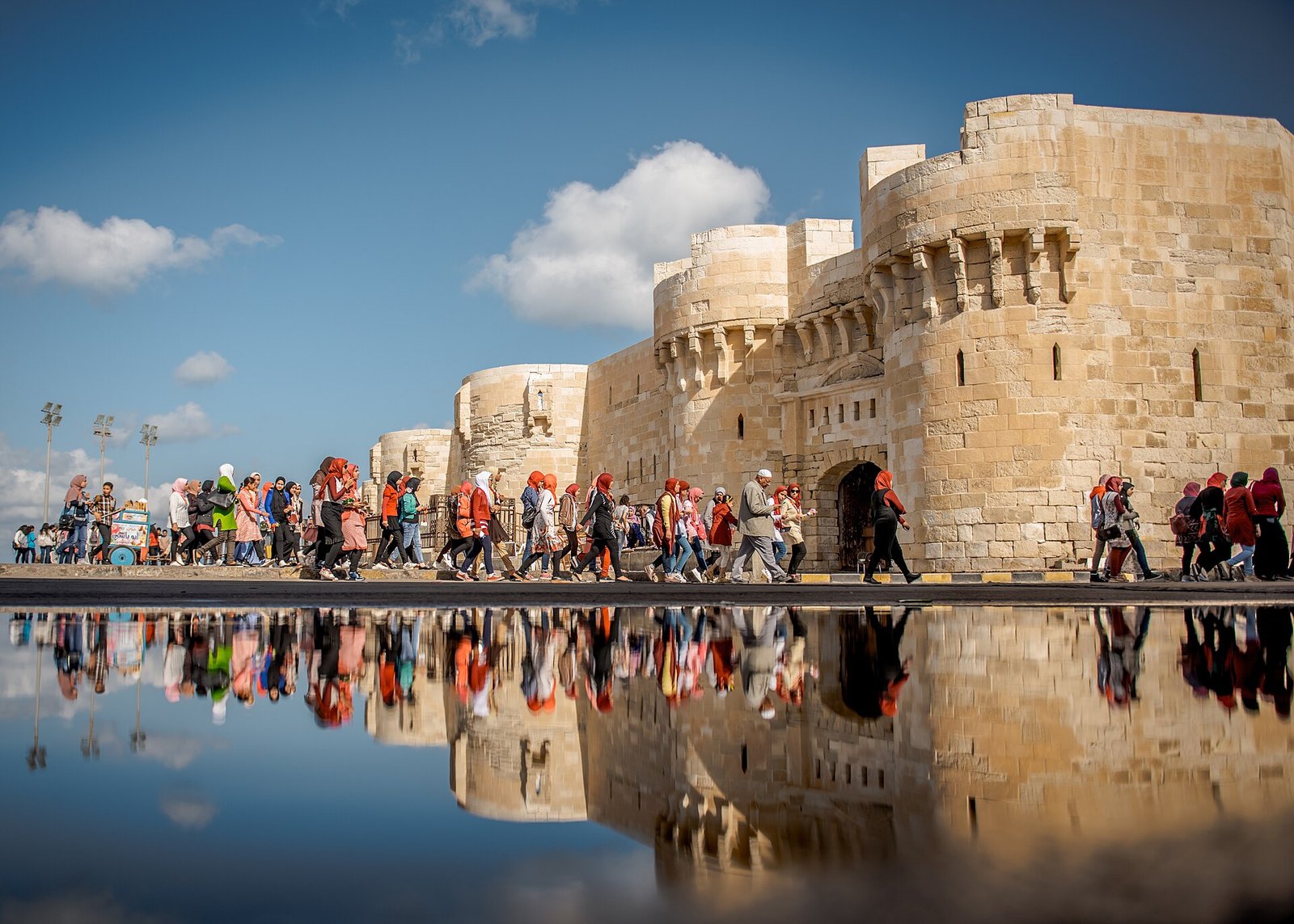
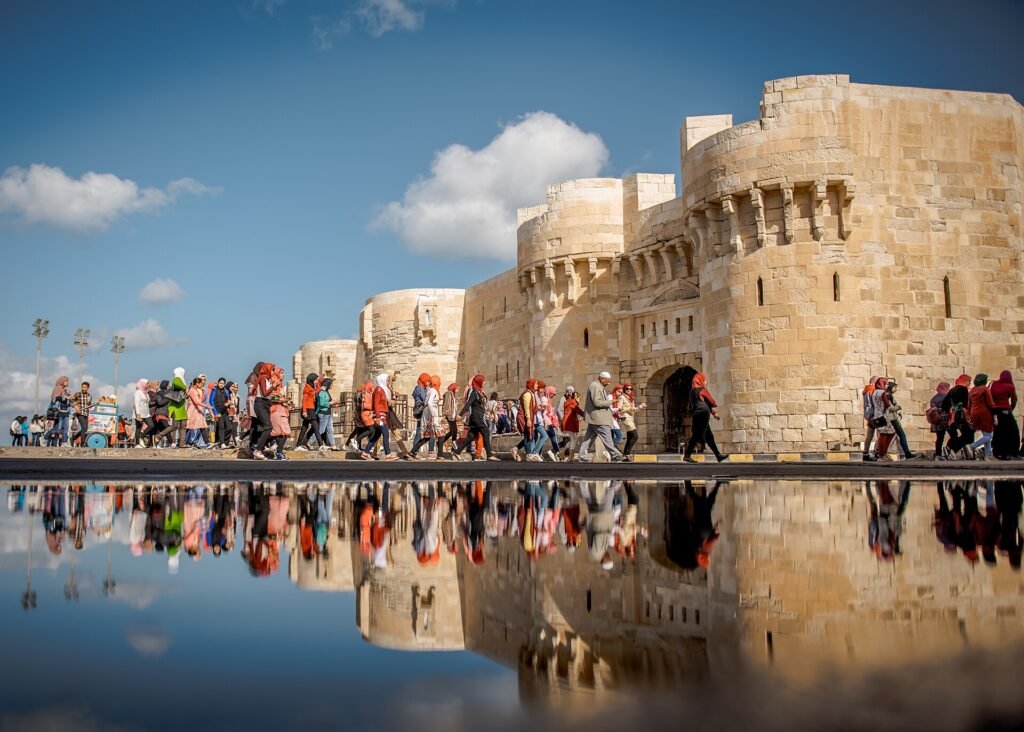
The Qaitbay citadel, standing where the Pharos lighthouse stood
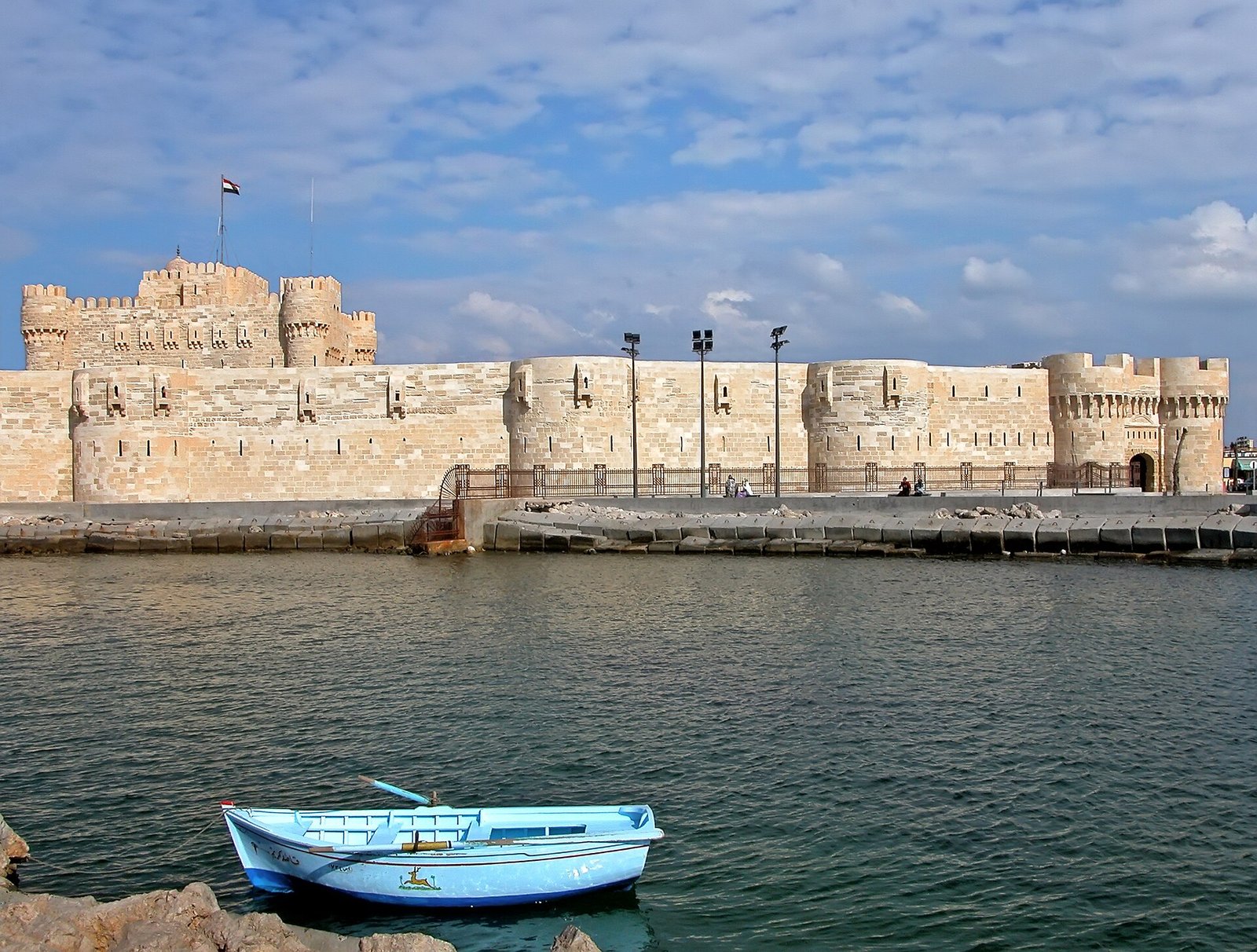
Start at the tip of the eastern harbor. The Qaitbay citadel is a compact limestone fortress built in the late fifteenth century by the Mamluk sultan of that name, and it sits on the precise footprint of the Pharos, the lighthouse that guided ships into Alexandria for over a thousand years until medieval earthquakes brought it down. The builders quarried the ruins; the red granite columns in the walls came from the lighthouse.
Inside there is not a great deal: a mosque in the keep, cisterns, corridors with slit windows. The point is the setting. From the ramparts you look back along the whole curve of the corniche and out to sea where the beam once swept. Give it forty five minutes, then walk the breakwater.
The quarter behind the citadel, Anfushi and Bahari, is the old fishing district and home to the best seafood in the city, which decides where lunch happens on our day trips.
The Bibliotheca Alexandrina, the modern library on the old idea
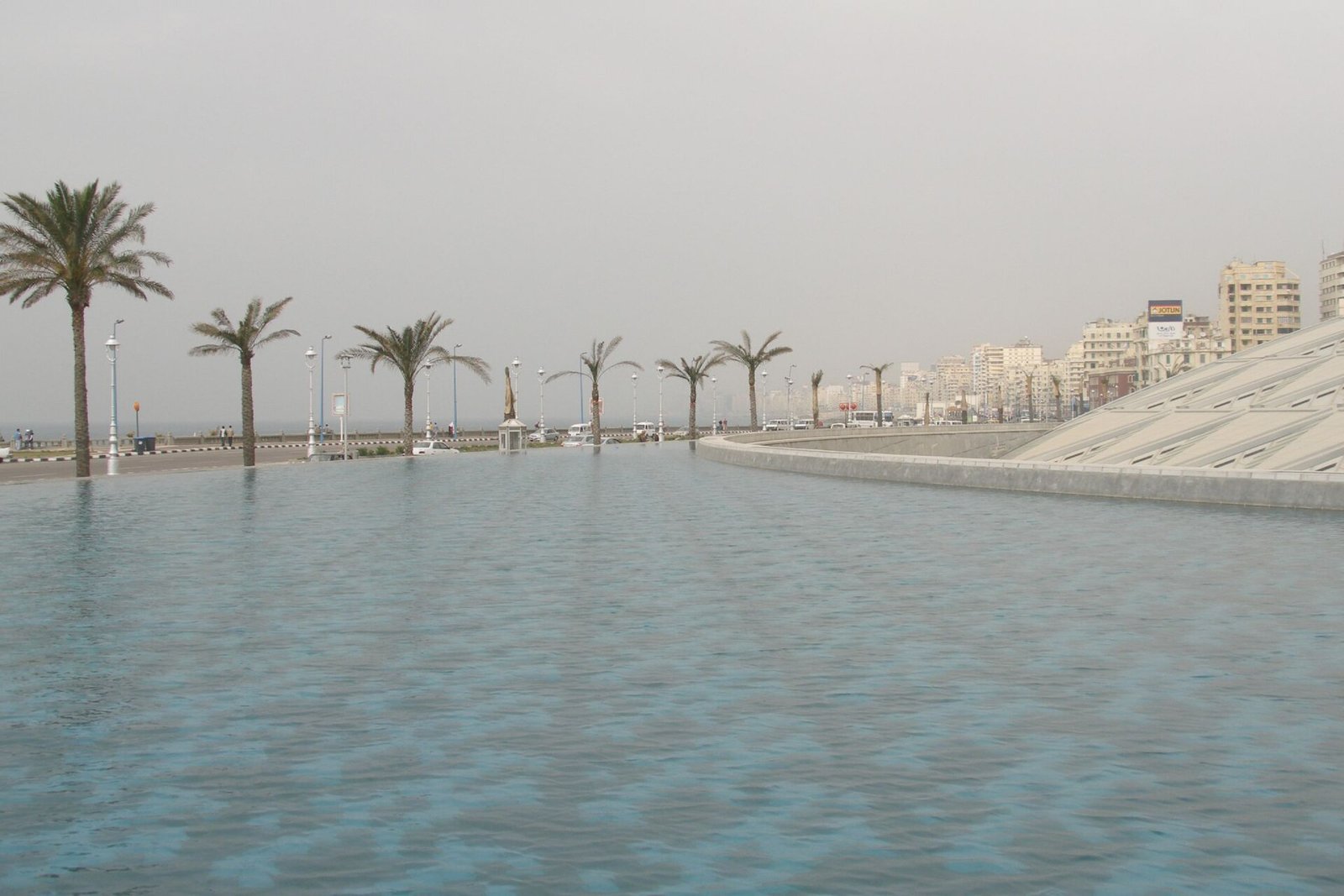
The ancient Library is gone and nobody knows exactly where it stood. The Bibliotheca Alexandrina, opened in 2002 a short walk east along the corniche, is the modern answer: a tilted granite disc rising from a reflecting pool, its outer wall carved with letters from most of the world's writing systems. Inside is a vast terraced reading room under a roof that lets in filtered daylight.
The Antiquities Museum inside, with statues raised from the harbor floor, is worth your time. Check the current tour schedule for the reading room when you plan.
Read our guide to the Bibliotheca Alexandrina, from the ancient library to the modern one before you go, then budget ninety minutes on site. On a day trip it comes after lunch, when the reading room is a cool place to sit.
The catacombs of Kom el Shoqafa, the strangest tomb in Egypt
If you see one ancient site in Alexandria, make it this one. Kom el Shoqafa means mound of shards, after the pottery that covered the hill for centuries. The catacombs beneath were found in 1900, supposedly when a donkey fell through the roof, and they are the largest Roman-era burial complex in Egypt, cut three levels into the rock in the second century AD.
You descend a spiral staircase around the shaft down which bodies were lowered, past a banquet hall where mourners ate in honor of the dead, into the main tomb chamber, and this is where it gets odd. The reliefs show Egyptian gods performing Egyptian rites, carved in Roman style. Anubis, the jackal-headed god of embalming, wears the armor of a Roman legionary. It is the one place where the three cultures of the city merge on a single wall.
Allow an hour, and wear shoes with grip; it is humid and the steps are worn.
Pompey's Pillar and the Serapeum hill next door
Five minutes from the catacombs, a single column of red Aswan granite stands on a low hill above the rooftops, roughly 88 feet (27 meters) from base to capital. Crusader-era travelers named it for Pompey. It has nothing to do with him. The inscription dedicates it to the emperor Diocletian at the end of the third century AD.
The hill matters more than the pillar. This was the Serapeum, temple of Serapis, the god the Ptolemies invented to unite Greek and Egyptian worshipers, and the site of the daughter library that held the overflow of the great Library's scrolls. Walk down into the rock-cut galleries and you can see the niches where scrolls were stored. Thirty to forty minutes is enough, and because it sits beside the catacombs the two are always done together.
Kom el Dikka, the Roman theater, and the Alexandria National Museum
In the middle of downtown, a Polish excavation in the 1960s uncovered a small Roman odeon, thirteen tiers of white marble in a tight semicircle, the only Roman theater found in Egypt. Around it are Roman baths, a row of ancient lecture halls, and the Villa of the Birds with its floor mosaics. Forty five minutes.
The Alexandria National Museum, a short drive away, is the museum we send people to when there is time for one. It occupies a restored Italian-style mansion, Pharaonic in the basement, Greco-Roman on the ground floor, Coptic and Islamic upstairs. It is compact and labeled in English, and an hour does it.
The corniche, Montaza gardens and the old cafes
The monuments are half of Alexandria. The other half is the seafront and the habit of sitting in it. The corniche runs for roughly 12 miles (20 kilometers) from the citadel to Montaza, and driving its length at the end of the day, with the sun going down behind the harbor and the fishing boats coming in, is the moment most guests remember.
Montaza, at the eastern end, is a walled park of palms and gardens around two royal palaces; the palace is closed, the gardens and seaside walk are open, and on a weekday out of season it is the calmest place in the city.
Downtown, look for the cafes and patisseries the Greek and Italian communities left behind. Several still have their original mirrors, marble tables and waiters in white jackets. Sit with a coffee, watch the trams pass, and you have understood something no monument teaches.
Eating in Alexandria, and how a fish restaurant works
Alexandria eats like a Mediterranean port, and it is the best reason to come that has nothing to do with archaeology. The fish restaurants of Bahari and Anfushi work like any harbor town in Greece, and you should know the routine.
- You walk to the ice counter at the entrance, not to a table.
- You choose from what came in that morning: sea bream, mullet, shrimp, calamari, crab.
- The fish is weighed in front of you and you agree how it is cooked: grilled over charcoal, baked in salt, or fried for the small ones.
- You sit, and the table fills with mezze you did not order: tahini, pickles, rice cooked in fish stock, warm bread. It is included.
Ask the kilo rate before the fish goes on the scale; every local does. Order sayadeya if you see it, the spiced fish and rice dish that is the city's signature.
Getting there from Cairo: the train versus a private car
Alexandria is about 140 miles (220 kilometers) northwest of Cairo. Two ways to make the trip suit two kinds of traveler.
| Option | Time each way | What you get | Best for |
|---|---|---|---|
| Private car with driver and guide | About 2.5 to 3.5 hours by the Desert Road, depending on Cairo traffic | Door to door, sites in the right order, lunch where we choose, corniche at sunset, back in Cairo that night | Almost everyone on a day trip |
| Train from Cairo Ramses to Alexandria Misr station | About 2.5 to 3 hours on the faster services | A window on the Delta, no traffic, arrival downtown; then a car or taxis between the scattered sites | Independent travelers staying a night or two, rail fans |
The train is pleasant, but the sites are spread out and the city's traffic is heavy, so a train day trip spends its middle hours in taxis. With a car and a guide who knows the order, you see the whole list between nine and five and sleep in your own Cairo bed. That is what most of our Cairo excursions guests choose. Ask us for the quote either way.
Day trip or overnight? An honest answer
A day trip works. Leave Cairo around seven, and by mid morning you are underground at Kom el Shoqafa. Pompey's Pillar follows, then the citadel, seafood in Bahari, the library in the afternoon, and the corniche before the road back. You skip Montaza, the theater and the museums, but you get the essence.
An overnight turns a checklist into a place. The city is at its best after five, when the office crowd fills the cafes and the corniche becomes one long promenade. The second morning covers Kom el Dikka, the National Museum and Montaza. It also opens two side trips.
- Rosetta (Rashid), about an hour east, the town where the Rosetta Stone was found, with Ottoman merchant houses on the western mouth of the Nile. Pair it with our guide to the Rosetta Stone and how it cracked hieroglyphs.
- El Alamein, about two hours west, the Second World War battlefield, cemeteries and museum.
Our rule of thumb: on a first trip of a week or less, do the day trip or give the day to Luxor instead. On ten days or more, or a second visit, spend the night. What to see in Cairo always comes first.
The best months to visit Alexandria, with temperatures
Alexandria has a different climate from the rest of Egypt, and it is the one destination where rain is a real possibility.
| Season | Typical daytime high | What it is like | Verdict |
|---|---|---|---|
| March to May | 68 to 79 F (20 to 26 C) | Clear and breezy, with occasional dusty khamsin wind days | Excellent |
| June to August | 84 to 88 F (29 to 31 C), humid | Sticky, and the city fills with Egyptian vacationers | Fine for the sites, avoid weekends |
| September to November | 73 to 84 F (23 to 29 C) | The sea at its warmest, crowds gone by mid September, golden light | The best months |
| December to February | 63 to 66 F (17 to 19 C) | Windy, with rain storms locals call the nawa, and bright days between | Good with a flexible plan |
For a day trip, October, November, March and April are the sweet spot. In winter we keep the Alexandria day movable within your Cairo stay, because a nawa storm turns the corniche into a wall of spray. Our page on the best time to visit Egypt puts the coast in the context of the whole country.
What to skip, and what to expect from the city as it is
Alexandria is not Luxor. The marble Greek city in your head is under the water and under the streets. What you get is a big, noisy Mediterranean port with a fragmented heritage, a beautiful seafront and an atmosphere that grows on you by the hour. Set expectations there and it is one of the most satisfying days in Egypt.
- Skip the city beaches. Crowded, murky, and nothing like the Red Sea.
- Skip Montaza on a day trip. It is far east and eats an hour in traffic.
- Skip the "Cleopatra's Bath" stops some drivers offer. The real story of the queen is in the harbor and in our guide to Cleopatra, the last queen of Egypt, not at a roadside rock pool.
- Dress a little more conservatively than at a resort. This is a big Egyptian city, and our guide to what to wear in Egypt applies in full.
One more thing to know: since the 1990s, underwater archaeologists have mapped the harbor floor and lifted sphinxes, colossal statues and granite blocks that may be pieces of the lighthouse, and at Abu Qir they found two entire port cities known until then only from Greek texts. The finds you can see are in the Bibliotheca and the National Museum, in glass cases.
How Explora Egipto runs an Alexandria day
We are a local agency in Egypt with our own guides and vehicles, and here the value is in the sequencing and the lunch. This is the standard day when you add it to a Cairo stay.
- Pickup at your Cairo hotel around seven, in a private air conditioned vehicle with your Egyptologist guide.
- Kom el Shoqafa and Pompey's Pillar first, while it is cool and the catacombs are empty.
- The Qaitbay citadel and a walk on the breakwater.
- Seafood lunch in Bahari, at a place we know, with the guide handling the counter so you just choose the fish.
- The Bibliotheca Alexandrina in the afternoon.
- Corniche drive past the old cafes, then back to Cairo by early evening.
The overnight version adds a hotel on the corniche, dinner downtown, and a second morning of Kom el Dikka, the National Museum and Montaza, with Rosetta or El Alamein as options. Both slot into any of our Egypt tour packages as an extra day in the Cairo section. Tell us how many days you have in Cairo, and we send you the quote.
Frequently asked questions
Is Alexandria, Egypt worth visiting?
Yes, if you have the day and you know what it is. Alexandria is the Greek and Mediterranean face of Egypt, with the citadel, the catacombs, the modern library and the best seafood in the country. It is not a monumental city like Luxor; on a very short first trip the south wins, on ten days or more it is a day people talk about afterward.
How far is Alexandria from Cairo and how do you get there?
About 140 miles, or 220 kilometers, to the northwest. By private car on the Desert Road it takes roughly two and a half to three and a half hours each way, depending on Cairo traffic. The train from Ramses station takes a similar time and arrives downtown, but you then need transport between the scattered sites.
Can you see Alexandria in one day from Cairo?
Yes. A well ordered day covers the catacombs, Pompey's Pillar, the citadel, a seafood lunch in the old harbor, the Bibliotheca Alexandrina and a sunset drive along the corniche, back in Cairo by evening. You give up Montaza, the theater, the museums and the city after dark, which is the case for one night.
What was the Lighthouse of Alexandria and can you see it?
The Pharos was a stone tower built under the early Ptolemies at the harbor mouth, one of the seven wonders of the ancient world, and it guided ships for over a thousand years until earthquakes destroyed it in the Middle Ages. Nothing stands today; the Qaitbay citadel was built on its site with its fallen stones.
What is the best time of year to visit Alexandria?
Spring and fall. March to May and September to November give you daytime highs from the high 60s to the low 80s Fahrenheit, roughly 20 to 29 Celsius, clear skies and a corniche you actually want to walk. Summer is humid and crowded; winter brings wind and rain between bright days, so keep the day flexible and we move it to the best forecast.
Is Alexandria safe and easy to walk around?
It is a busy, ordinary Egyptian city and it feels safe by day and evening in the areas visitors use: the corniche, downtown and the old harbor. The sites are too spread out to walk between, so you want a car for the day and your feet for the seafront and the cafes. Dress a little more modestly than on the Red Sea.
See the Mediterranean side of Egypt with a local guide
Tell us your dates, how many days you have in Cairo, and whether you would rather do Alexandria in a day or sleep by the sea. We come back with the plan, guide and vehicle arranged, and the quote in your inbox.